Preparing for future work in this field, I am trying to develop a universal web analytics template based on which I could plan my work in the future. Reading books and information from various sources, I can summarize it as follows:
✔ Setting goals (SMART principle)
✔ Defining methods of collecting and storing information
✔ Implementing data collection tools (such as Google Marketing Tools & Hotjar)
✔ Data collection
✔ Aggregating data and preparing them for analysis
✔ Data analysis
✔ Conclusions and corrections
❗ This cycle will be repeated and improved with each analysis conducted!
If we analyze the requirements for knowledge of web analysts in job postings, they tend to focus more on technical analysis: knowledge of implementation of analytic tools and programming languages such as Python and JavaScript. In my opinion, these are just ways of obtaining data, while the focus should be on studying users and asking the right questions for analysis.
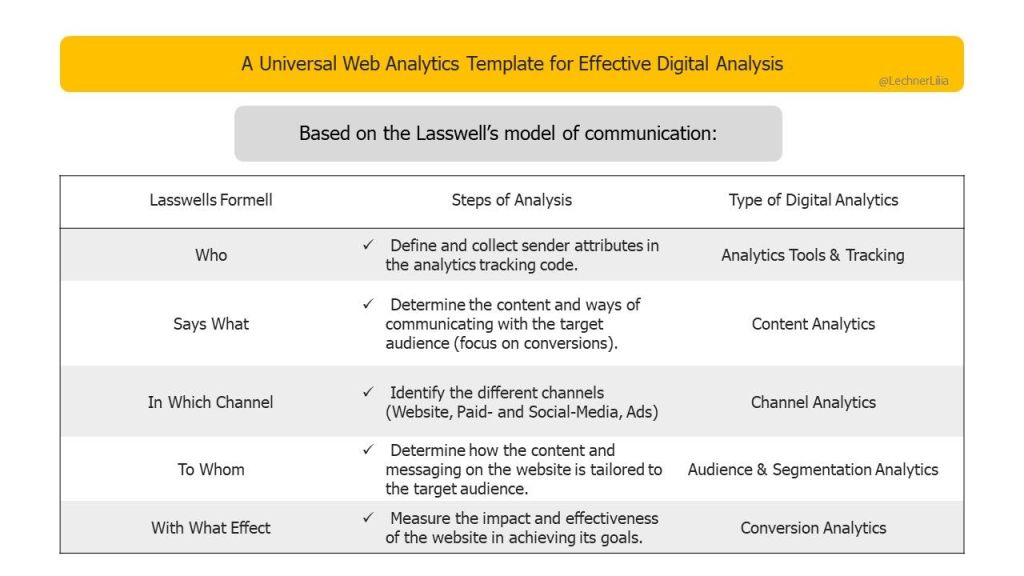
One of the models I would choose for analysis is the classic model of communication proposed by Harold Lasswell, a prominent political scientist and communication theorist.
👉 The Lasswell’s Formula is:
“A convenient way to describe an act of communication is to answer the following questions: Who says what in which channel to whom with what effect?”.
This model represents a framework for analyzing the elements involved in communication, for example:
1️⃣ Who: Define and collect sender attributes for example in the analytics tracking code.
2️⃣ Says What: Determining the content and ways of communicating with your target audience with a focus on conversions.
3️⃣ In Which Channel: Identifying the different channels through which users can access the website and get your message.
4️⃣ To Whom: Determining how the content and messaging on the website is tailored to the target audience.
5️⃣ With What Effect: Measuring the impact and effectiveness of the website in achieving its goals.
By following this formula, one can develop a plan for comprehensive digital analytics, including Campaign Analytics (Paid Media and Ads); Web Analytics (Owned Media) and Social Media Channels, to gain an understanding of user behavior, the effectiveness of website content, and marketing efforts. You can also use these steps in reverse order!
Thank you for your time and attention! 😘
 analyticswithlechner